
Chokepoints: geography as destiny
For centuries, a few kilometres of open water have dictated the fate of empires. They still do.

Foreign Affairs Newsletter
Written by Luca Salvemini
No. 153 - March 15, 2026
Mexico is the eleventh largest oil exporter in the world.
Its median age is under 30. Its economy has grown steadily for years.
It is deeply embedded in the American value chain, with bilateral trade at $900 billion.
Yet Mexico has never been absorbed.
Against the pull of the world’s dominant power, it has built an identity that resists assimilation—a cultural canon stubbornly its own.
Today, roughly 40 million Mexicans live in the United States. They are the country’s most powerful geopolitical instrument: a diaspora tuned to Mexican identity, capable of shaping American politics from within.
An emerging power with a long game.
On March 26, the first issue of Strategic Atlas examines what that game looks like.
This column will be reserved for paying subscribers.
I want to sincerely thank those who are subscribing these days.
Your support, including financial, gives me access to the most valuable sources and databases worldwide, allowing me to be precise and thorough in my research.
My commitment is the only tool I have to repay your trust.
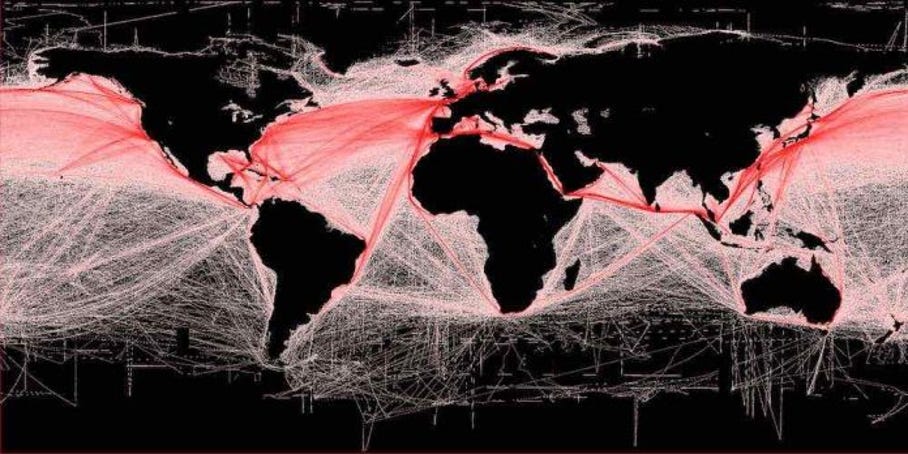
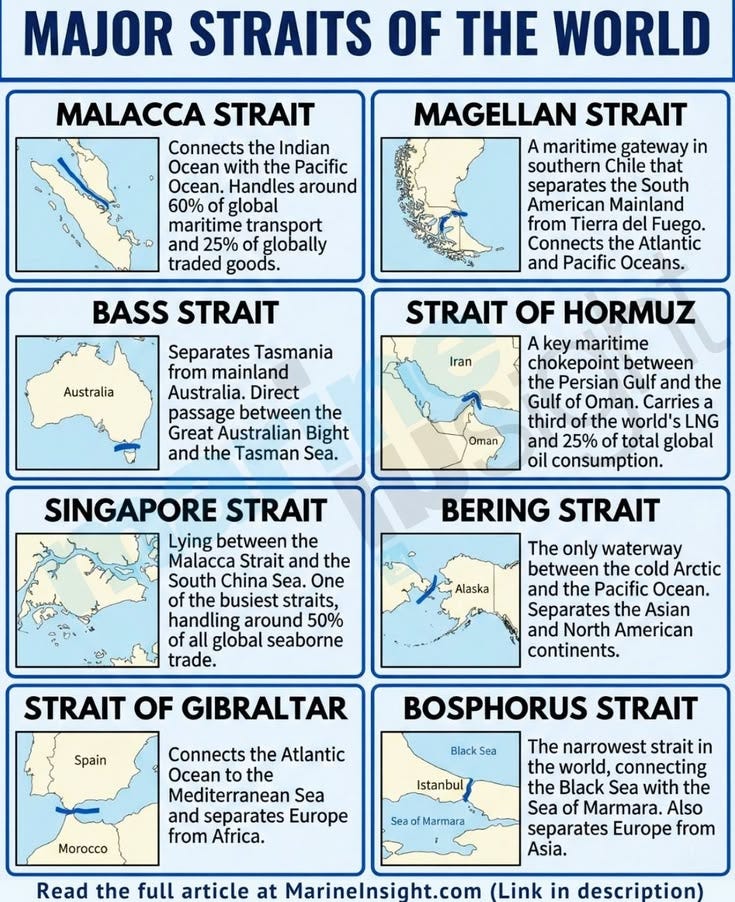
Choke points are straits and channels — natural or artificial — that constitute the mandatory passages of global maritime trade.
Today, ninety per cent of world trade by volume travels by sea; and a significant portion of that traffic is compelled to pass through these slivers of water, often no more than a few kilometres wide.
The capacity to control them determines the balance of power among the world’s major nations.
Their deliberate closure becomes a formidable geopolitical weapon: it strangles the flow of goods, energy and raw materials.
Beneath many of these straits run submarine fibre-optic cables as well.
From the eighteenth century onwards, one state dominated the world through sea power for more than two centuries: England — a quintessential thalassocracy, commanding the most powerful fleet on earth and maintaining colonial bases at every strategic node.
After the Second World War, that primacy passed to the United States, which today sustains approximately eight hundred military installations across more than seventy countries.
To control the choke points, for those who exercise this hegemony, is to exercise dominion over the planet.
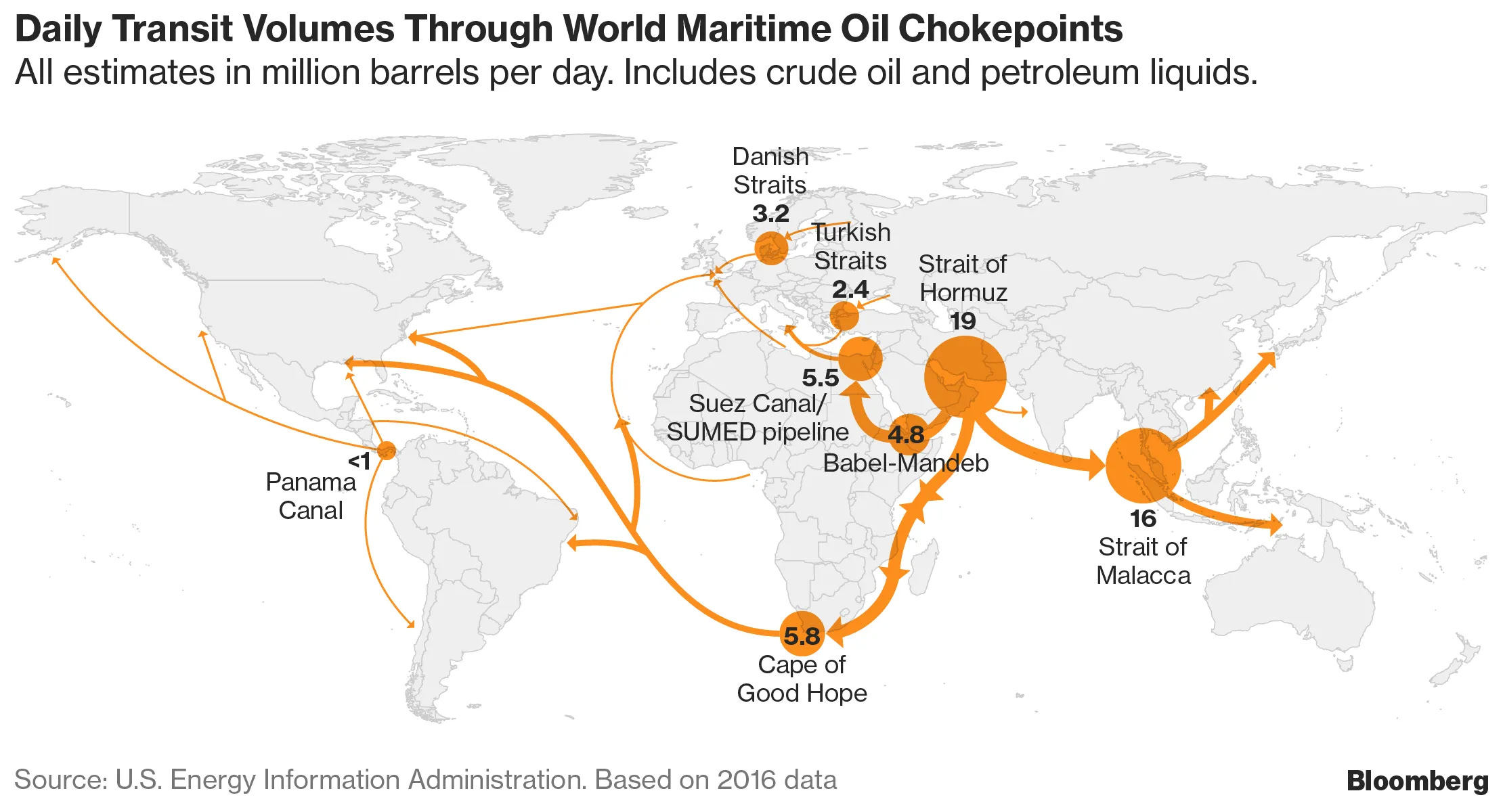
Consider the Suez Canal and the Strait of Bab el-Mandeb.
The former, inaugurated in 1869, is an artificial waterway in Egypt that reduced the Eurasian shipping route from forty-four to twenty-six days, rendering the circumnavigation of Africa obsolete.
The Strait of Bab el-Mandeb, at the mouth of the Red Sea — approximately forty kilometres wide at its broadest point and one hundred and thirty kilometres in length — separates the Horn of Africa from the southern tip of the Arabian Peninsula and serves as the southern gateway toward European ports.
In 2023, these waters carried between ten and twelve per cent of global merchandise trade, eight per cent of liquefied natural gas, and eleven per cent of crude oil and petroleum products.
From November 2023 onwards, with the Houthi attacks on container vessels bound for the Mediterranean and Israel, the area was transformed into a theatre of conflict.
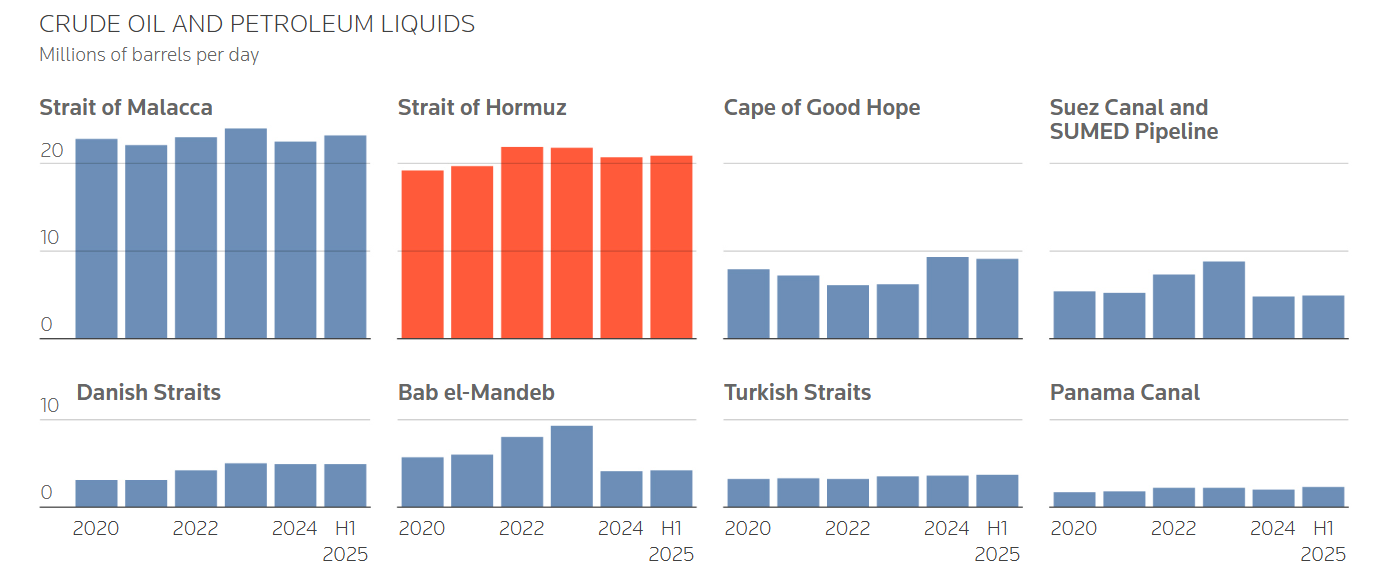
According to Portwatch data, in the period between January and June 2024, the daily average of vessels transiting the Suez Canal fell to thirty-six — less than half the seventy-four recorded during the same period of the previous year.
In the Strait of Bab el-Mandeb, the figure dropped from seventy-five to twenty-nine.
Before arriving at Hormuz, it is instructive to recall a historical episode that illuminates the present with uncommon clarity.
The Dardanelles Strait conventionally marks the boundary between Europe and Asia, and the demarcation line between European and Asian Turkey.
To the north lies the Bosphorus — approximately thirty kilometres long and no more than seven hundred metres wide at its narrowest point — connecting the Sea of Marmara to the Black Sea; to the south, the Dardanelles proper — sixty-eight kilometres in length, 1.2 kilometres wide — joining the Sea of Marmara to the Aegean.
Their particular morphology renders them among the most treacherous choke points to navigate, above all for large-tonnage tankers. Over thirty-six thousand vessels transit the Bosphorus annually.
It was here that a decisive episode unfolded: the Dardanelles Campaign of 1915.
The British and French objective was straightforward in conception: force the strait, neutralise Ottoman coastal batteries, open the road to Constantinople and compel the Ottoman Empire to exit the First World War.
The plan called for a massive naval assault — battleships, then among the most powerful afloat, would bombard the coastal fortifications while civilian minesweepers cleared a corridor through the minefields.
The Allies were confident that naval supremacy would suffice.
On the night of 8 March 1915, a small Ottoman minelayer, the Nusret, executed a manoeuvre that was almost invisible yet utterly decisive.
It laid twenty-six naval mines in a line parallel to the shore in Erenköy Bay, precisely in the area where Allied battleships habitually manoeuvred to reverse course during their bombardments.
The field went undetected by the minesweepers.
On 18 March, the Allied fleet entered the strait for the decisive assault. During the turning manoeuvre, three battleships struck mines: the French Bouvet sank within minutes with hundreds of men aboard; the British HMS Irresistible was destroyed; HMS Ocean went down during the attempted tow.
Within hours, the fleet had lost a significant portion of its operational capital ships. The Admiralty concluded that the strait could not be forced by naval power alone.
Unable to proceed by sea, the Allies resolved to land troops on the Gallipoli Peninsula in April 1915.
That landing degenerated into a prolonged war of attrition against Ottoman forces led in part by Mustafa Kemal Atatürk, and the campaign ended in Allied withdrawal in January 1916.
An operation designed to alter the balance of a world war, undone by twenty-six mines laid by a comparatively modest vessel.
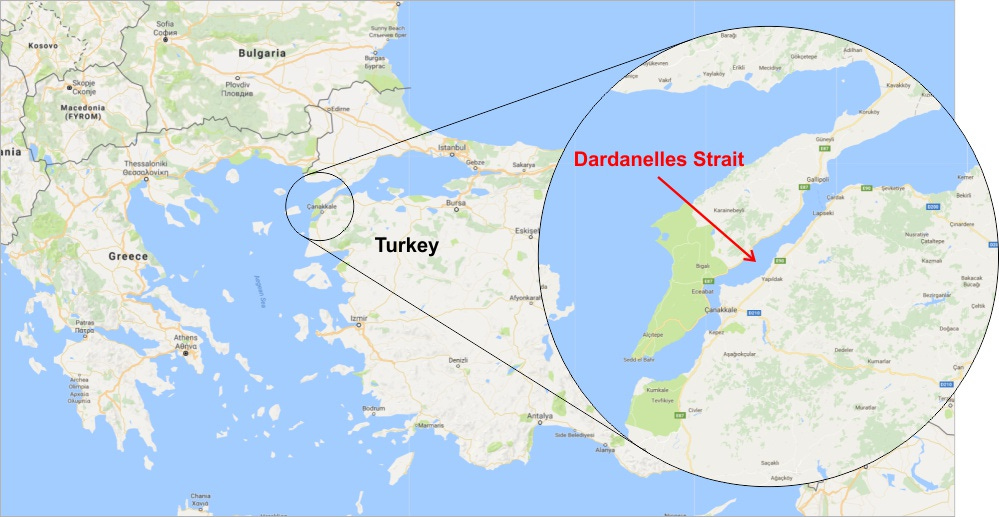
As Caitlin Talmadge of MIT has observed, in the Dardanelles as in the Strait of Hormuz, the geographical configuration allows the defending party to draw enemy vessels close to shore, where they can be engaged far more effectively. In confined waters, America’s technological advantages are substantially diminished. Drones and missiles reach their targets with greater ease.
Which brings us to the present.
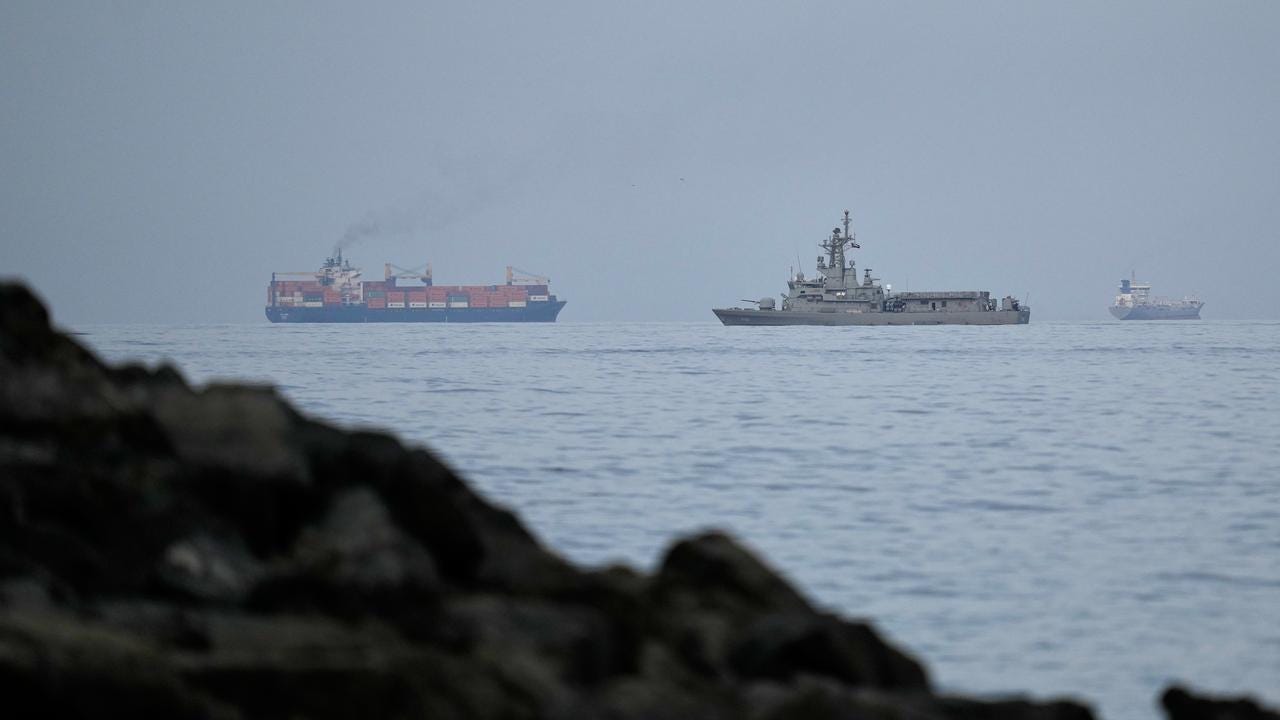
In the Strait of Hormuz, the first attacks were carried out on Tuesday.
The Thai vessel Mayuree Naree was the initial target; the Liberian-flagged Express Rome followed. In the space of a few days, six ships have been struck in total, in addition to the ten hit since the war began.
The gravity of the situation is such that Western governments have authorized the largest coordinated release of strategic reserves: we are already tapping them, buying time at a steep price.
According to Goldman Sachs, if the Strait of Hormuz were to remain closed or even heavily restricted for a few weeks, oil prices could reach around $150, the highest level since 2008.
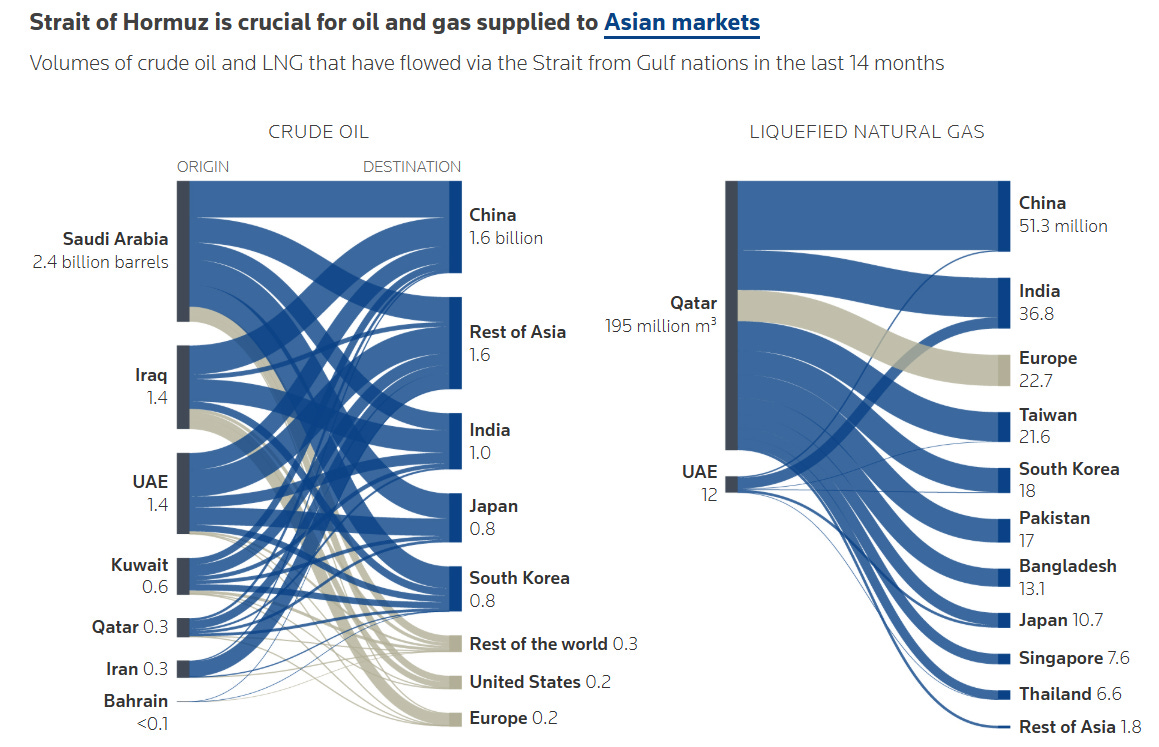
But the problem would not be limited to crude oil: through that shipping lane pass (or passed, before the fighting began) more than 20% of the world’s oil production, one-fifth of liquefied natural gas, one-third of fertilizers, 15% of aluminum, and 30% of helium, a gas essential for semiconductor production.
The U.S. government says its warships will escort tankers, a promise that sounds like control but is really just another slow-motion traffic accident.
It reveals that, for now, the United States controls almost nothing.
Europe has increasingly bought gas from the Middle East since Russia’s invasion of Ukraine. Asia is heavily dependent on oil from the Persian Gulf. Everywhere, the price of fertilizer is rising, and with it food; the price of gasoline, and thus transport; the price of energy, and thus industry.
In short, everything.
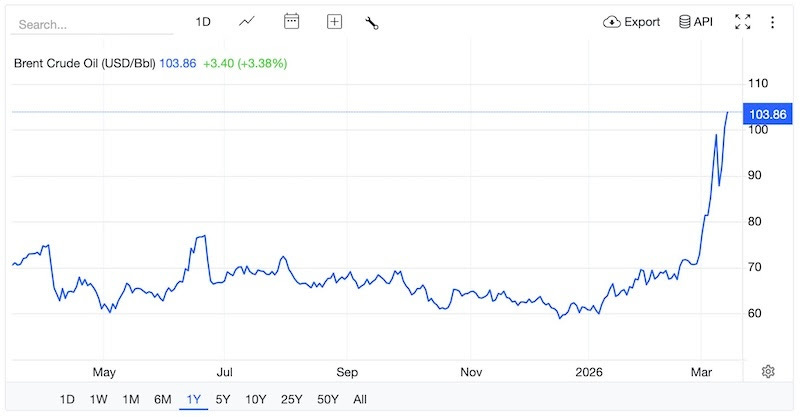
It is not only the tapping of reserves that shows how difficult the situation is.
The United States has suspended a century-old law to allow foreign tankers to navigate its inland waters. Then it authorized India to buy Russian oil.
Then it lifted sanctions on Russian oil already loaded onto ships.
Who will be next to ask to buy Russian oil again?
The strategic military exploitation of the strait was confirmed by the opening statements of the Islamic Republic’s new Supreme Leader, Mojtaba Khamenei, who declared that “the lever of blockading the Strait of Hormuz must absolutely continue to be employed”.
Iran has been constructing its asymmetric warfare around that fundamental asset for decades.
Since the 1980s, the Tehran regime has repeatedly threatened to close or render chaotic the passage through the thirty-three kilometres that, at their narrowest, separate the Omani peninsula from the Iranian coast.
It does so not only through direct military projection — which remains inferior to that of the United States or Israel — but above all through the activities of its proxies, most notably the Houthi militia in Yemen, and through the threat of low-cost disruption: suicide skiffs, mines and drones that cost a few thousand dollars to deploy and compel adversaries to activate defence systems costing orders of magnitude more.
The critical difference from the 1980s lies in the fact that, whereas during the Iran-Iraq War the regime sought to avoid total escalation with the United States, today the notion that Tehran might be restrained by fear of consequences appears wholly unrealistic.
For the Islamic Republic, this is, in the most fundamental sense, a war of survival.
Numerous analyses of the conflict have converged on a single, damning observation: the United States entered this war with striking improvisation — unprepared forces, no coordination with European allies, no passage through the United Nations, a systematic underestimation of Iranian retaliatory capabilities.
According to some independent estimates — which should be treated with appropriate caution, given the difficulty of independent verification — daily operational costs to the White House range between nine hundred million and one billion dollars.
Figures that are, over any extended timeline, unsustainable even for a power of America’s magnitude; and to which must be added the indirect costs and the mounting political liabilities.
Moscow and Beijing could furnish Tehran with the intelligence necessary to improve the precision of strikes against American assets in the Gulf.
The region’s placid monarchies, hitherto principally absorbed in the business of prospering in peace, are now on the receiving end of Iranian missiles and have begun to question whether granting the United States military basing rights on their soil was, in retrospect, prudent.
It is conceivable that Iran proves to be a paper tiger and that, after another week of sustained bombardment, it is compelled to capitulate.
But should that not be the case, Trump’s wager risks turning decisively against him.
Arriving at the November midterm elections still mired in a Gulf war — with petrol prices soaring, flag-draped coffins returning home and inflation climbing — could mark his political end.
The sociologist Ulrich Beck once distilled the passage to modernity into a formula that has lost none of its precision: before modernity transformed society, human beings expressed a single fundamental need — “I am hungry.”
Today, in a chaotic and non-inclusive modernity, the majority say instead: “I am afraid.” It is in that soil that populisms take root and democracies erode.
As Professor Giuliano Noci writes, the old ordered chessboard no longer exists.
The world today more closely resembles a vast seismic fault: tectonic plates grazing, compressing, drifting apart. Ideologies have evaporated; what remain are interests.
Global value chains have interwoven economies to such a degree that every geopolitical decision acts as pressure upon the plates.
Alliances become mobile, elastic, frequently contradictory.
The arbiter of the international system — multilateral institutions — appears increasingly incapable of containing these pressures. Geopolitics thus reverts to its most ancient grammar: that of force, of immediate interests, of naked strategic survival.
From the Dardanelles to the Strait of Hormuz, history teaches that military and technological superiority is insufficient when geography and asymmetric tactics are underestimated.
A minor obstacle — a mine, a localised incident — can alter the global equilibrium.
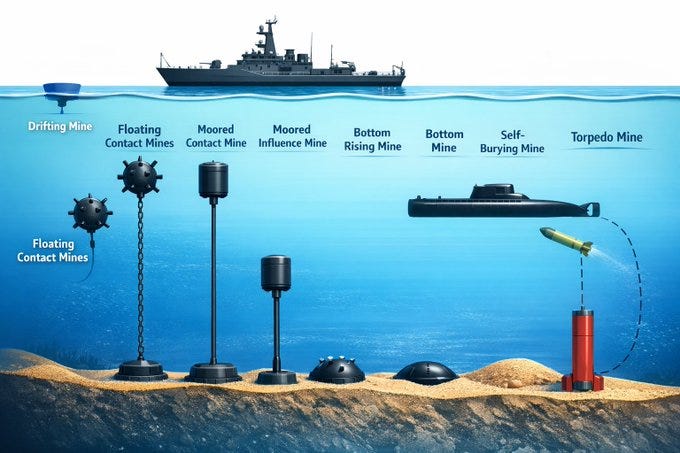
In an ever more interconnected world, the vulnerability of a single strategic passage may translate into economic and political consequences of the widest possible compass.
History reminds us that prudence, intimate knowledge of the terrain and the anticipation of risk remain irreplaceable instruments for those who would genuinely govern the dynamics of the world.
How is it that all of these "experts" make the statement that the US was totally unprepared for Iran's asymmetrical war strategy? What if the intelligence community was fully aware that this would be the response, but decided that Iran had to be stopped anyway? Do they even consider that possibility?
Geography may still matter—but not in the old way.
In the twenty-first century, the real chokepoints are financial networks, semiconductor supply chains, and digital infrastructures.