
As soon as we can
Merz's Munich speech and Germany's race to rearm Europe.

Foreign Affairs Newsletter
Written by Luca Salvemini
No. 148 - February 15, 2026
Dear readers, soon - in March - I’ll be launching a new monthly series.
It’s called “Strategic Atlas“ and it will be a focused report dedicated to a single country, different each time, with three analytical drivers that will help you decode the geopolitical dynamics that truly matter.
For each country I’ll analyze:
Geography and strategic resources - what structurally determines its choices
Power architecture - who really holds power and what the internal fractures are
International positioning - where it stands on the global chessboard
The first issue will focus on a major South American country that is redefining its role on the continent and in global power rivalries.
This series will be exclusively reserved for paid subscribers.
If you’re not yet a paid subscriber, now is the right time.
I have always been fascinated by the liturgies of international diplomacy.
The care taken in rendering declarations, the words doled out and selected one by one, the gestures and photos taken on the margins of international summits.
All of this contributes to building a State’s projection abroad, its ethos, its statement on the international situation in which it moves.
The ensemble of these details provides observers, analysts, and journalists with a photograph of the state of the world. A thermometer of how things are truly going.
To appreciate and evaluate these and other nuances, I was awaiting the annual Security Conference that opened in Munich on February 13th.
The Security Conference is an event attended each year by dozens of heads of state and government and institutional representatives.
Many observers emphasized its importance in light of what happened last year, on the margins of the same Conference.
Last year, as we discussed in this newsletter, the stage was dominated by the harsh reprimand from the then freshly appointed American Vice President J. D. Vance toward European states.
It was that speech, to remain on the theme of declarations and messages, that anticipated what would become the new American administration’s posture toward the rest of the world, especially toward its historic European allies.
“The threat I fear most when it comes to Europe is not Russia. It’s not China. It’s not any external actor. What I fear most is the threat from within.”
Through twenty minutes of discourse, Vance and the American entourage chose the authoritative stage of the Munich Security Conference, the strategic and geographic heart of the Atlantic alliance, to harshly criticize European censorship of freedom of expression, the weakness of democratic principles due to the prohibition on certain far right parties from participating in elections, as well as the absence of limits on migratory phenomena which would have determined an inevitable fragility in the social fabric of European countries.

Vance’s “provocative” speech served as a shock to the audience but above all inaugurated the profound deterioration in transatlantic relations under Trump, with emphasis on cultural and values based divergences as well as geopolitical ones.
That was February 2025. Fast forward to today.
Behind the scenes accounts tell us that, precisely in light of the speech Vance delivered last year, German Chancellor Friedrich Merz had requested, and obtained, to be the first to speak at this year’s Conference.
The reason for this request was soon understood.
Merz’s speech was of unusual harshness and frankness, compared to the usual lexical parsimony of diplomatic jargon, and had as its principal objective the American President, Donald Trump.
Merz’s words are particularly important because it is from Germany that a tendency is consolidating itself, one that is increasingly taking hold among European states regarding the management of their relations with their historic American ally.
Merz is the leader of a center right party and until a few months ago had shown himself conciliatory toward Trump, in an attempt to maintain good relations. Recently he had begun to criticize him more often.
In Munich, Merz stated that “the international order based on rights and rules is currently being destroyed. This order, however imperfect it may have been even in its best times, no longer exists in that form.”

He added that Trump’s policies have called into question the United States’ leadership position and have caused a “profound fracture” with Europe, historically their ally.
“The culture wars of the United States are not ours. And we do not believe in tariffs and protectionism, but in free trade.”
In his speech, Merz did not spare even the European Union and its member countries, for example for not having done enough to strengthen their own security and to grow the economy independently of the United States: “Our freedom can no longer simply be taken for granted. It is threatened.”
While using harsh and critical tones toward the United States, Merz nevertheless insisted on the necessity that the European Union and United States continue to collaborate, also through NATO, the military alliance of which almost all Western countries are members.
For these passages, Merz switched from speaking in German to English, precisely to address Trump and the United States directly.
Although in his own way he gave the impression of not wanting to completely break the alliance, even in this case the tones were not conciliatory: “In the era of great power rivalry, not even the United States will be powerful enough to act alone,” he said.
And it is precisely on the themes of security and defense that I found interesting, given Germany’s peculiar history, given the delicacy with which it has always considered its rearmament and investments in its own defensive capabilities, the passage in which Merz stated:
“We will make the Bundeswehr the strongest conventional army in Europe as soon as we can.”
To fully evaluate this statement, it is indispensable to consider the chronology and choice of words and tones.
These are speeches prepared for weeks, this is not improvisation.
The German Chancellor, in the same speech in which he announces the destruction of the world order as we have known it until today, informs the global audience that Germany, a country with a considerable post Nazi “pacifist culture” and with an enormous historic taboo on aggressive rearmament, will equip itself, “as soon as we can” with the strongest conventional army in Europe.
Germany has approved a package of reforms that will allow it to invest a core budget for defense (Bundeswehr) equal to €82.7 billion in 2026, with an increase of €20.2 billion compared to 2025 (growth of approximately 32%).
In percentage terms of GDP, we are talking about approximately 2.5 to 2.83% in 2026, with the goal of reaching 3.5% by 2029.
This represents a historic record since the end of the Cold War.
In parallel, the same Merz has confirmed conducting, for over a year, confidential talks with French President Macron who has long advanced the proposal to “Europeanize” the French Force de Frappe (France’s independent nuclear deterrence). The objective is to develop a European nuclear deterrence as a complement to the American umbrella (according to French sources, Poland, Sweden, Denmark, and the Baltic countries also participate in the dialogue).
In 2025, about two thirds of Germans considered the Russian army a threat, according to a survey by the Ministry of Defense. The survey also found that 64% of Germans believe defense spending should be increased, compared to 57% in 2024.
Another 65% think Germany should have larger armed forces, compared to 58%.
Merz’s Munich speech confirms that tendency that has been increasingly delineating itself in recent weeks: European states are attempting to respond to the proclaimed isolationism, the American disinterest toward the European continent.

Further examples in this direction have been the signing of two agreements like Mercosur and the free trade agreement signed between the European Union and India.
These are two agreements that, beyond the economic and political aspects of significant relevance, carry with them a strong symbolism.
On one hand, MERCOSUR (EU plus Argentina, Brazil, Paraguay, Uruguay; Bolivia will be able to join in the future) creates one of the world’s largest free trade zones (approximately 700 to 800 million people, approximately 20 to 30% of global GDP) and aims to eliminate or in any case strongly reduce tariffs on over 90% of products and services (for example, automobiles, machinery, agri food from the EU; meat, soy, ethanol from Mercosur).
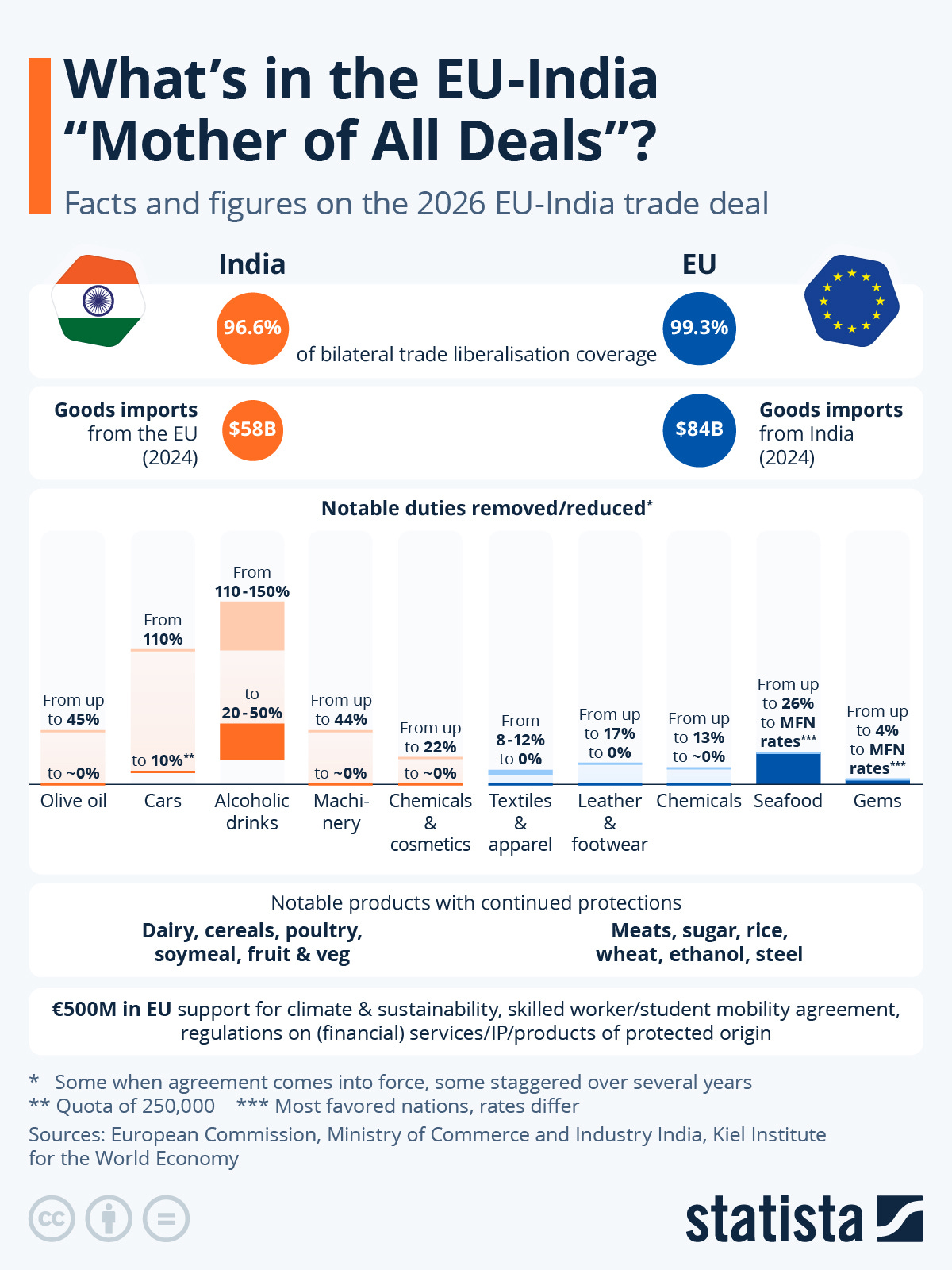
On the other side, the agreement signed between the European Union and India is even more important as it is exemplary of a true autonomous European commercial policy, independent of Washington’s wishes and which will allow, moving toward complete implementation, the creation of the world’s largest free trade zone with over 2 billion people involved, equal to approximately 25% of global GDP.
Both negotiations for the two agreements had been initiated many years ago, Mercosur actually 25 years ago, the agreement with India 20 years ago, but there is no doubt whatsoever that the uncertainties emerging from the new posture of the United States, the resurgence of conflicts and increasingly unstable scenarios, have induced the European Union to accelerate and conclude the first true dual attempt at commercial diversification.
Thus the pieces of this intricate puzzle begin to complete themselves and interlock.
Merz’s speech, German and European rearmament, the signing of two gigantic commercial agreements, and today the tones of European leaders toward the American administration significantly harsher compared to a year ago.
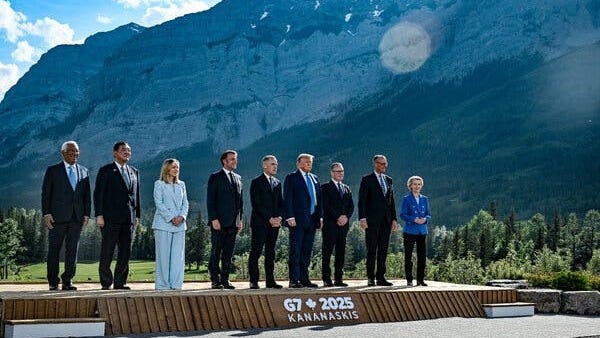
All these elements signal the emergence of a healthy principle of realism and geopolitical flexibility that European leaders are beginning to make their own and put into practice.
After the end of the Cold War, with the affirmation of American unipolarity, the European Union was the place where it was factually demonstrated how free trade, the free flow of people and capital, appropriate regulation that protected and made predictable the relations among people, businesses and states, international law, were by far more economically advantageous compared to the use of force and arms to settle disputes among states.
This model foresaw the total delegation of European defense to the charge of the military and warfighting capabilities of the United States.
An asymmetric model, totally unbalanced, with many European states that never reached or respected the budget objectives on defense investments required by the treaty for NATO membership (2% of GDP).
This model, as Merz declared in Munich but also the Canadian Prime Minister himself at Davos, is today in a phase of strong transformation.
I do not believe it is yet completely archived, provided that European states continue to persevere in defending principles such as the rule of law, the separation of powers, vigilance over conflicts of interest, and the existence of independent authorities.
Irony of fate, these are the elements that led to the economic success of the United States itself, then becoming a model for much of the world.
Having occupied Germany after World War II, the United States imposed on the newborn Federal Republic of Germany the creation of two institutions: first, the Deutsche Bundesbank, an independent central bank modeled on the Federal Reserve System, conceived to avoid the repetition of the hyperinflation that had contributed to the rise of Nazism.
Second, the Bundeskartellamt, a competition authority modeled on the Federal Trade Commission and the Antitrust Division of the American Department of Justice, endowed with the powers necessary to prevent the reappearance of cartels and trusts in heavy industry, another factor that had contributed to triggering Hitler’s aggression and the beginning of World War II. Subsequently, at the request of Germany itself, and on the basis of its democratic and economic rebirth, these two institutions were transposed to the level of the European Union.
The writer Antonio Scurati has written that, after World War II, Europe accomplished a true “renuntiatio ab imperio” (renunciation of empire), relegating any imperial ambition to the USA and leaving Europe as a “continent without qualities” (Peter Sloterdijk), an empty stage of violent conquests.
Today Merz’s words - even the rapprochement of great countries like the United Kingdom which, in fact, has initiated a concrete U turn to return to the European table, “we are not the Britain of the Brexit years any more” the British Prime Minister said in Munich - signal not a rediscovered imperial aspiration on the part of European states, but rather a rediscovered awareness, a reinvigorated political pride.
There is still an enormous amount to build, simplify, implement to obtain a true political union among European member states that would render them capable of competing geopolitically with Russia, China, and the United States.
However, Merz’s speech, his indispensable leadership, and the jolt coming from the German country allow us at least to be moderately optimistic about the survival of a brilliant idea called Europe.
Great piece! Merz has been facing pressure in Germany for his Trump-friendly approach, particularly since Trump renewed his threats against Greenland. There is hope now we in Europe can use the absence of our greatest ally to strengthen our continent. Nevertheless, Merz is facing domestic troubles with crucial elections coming up this year.