
Two Symphonies, One World
How Beijing institutionalized its alternative to the American technological order, and why most of the planet is already choosing its conductor.

Foreign Affairs Newsletter
By Luca Salvemini
No. 171 - 19th July
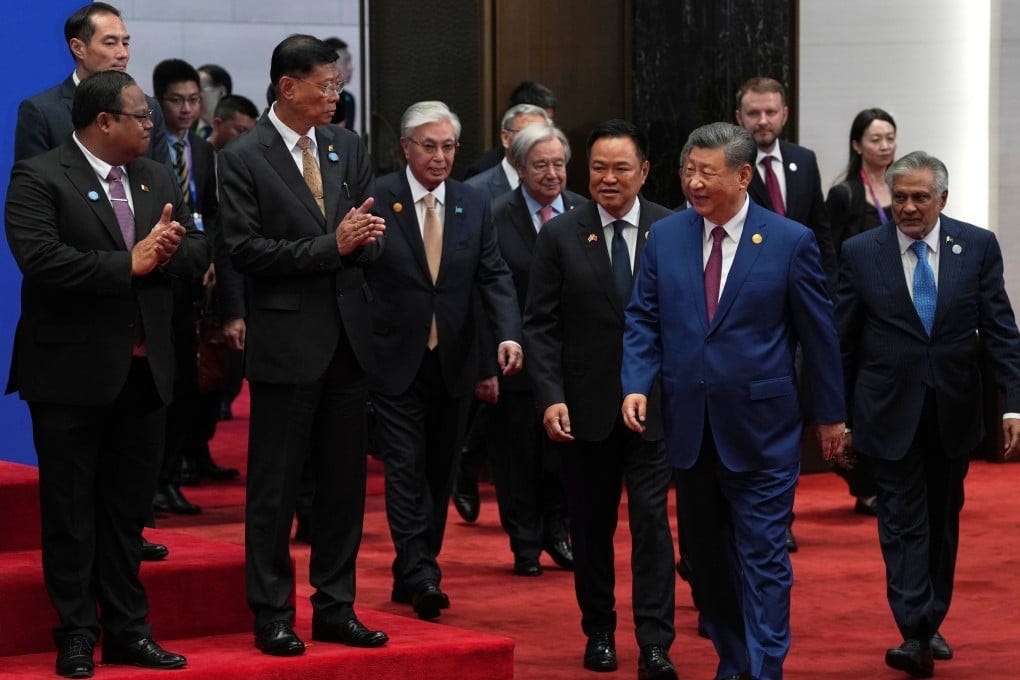
On July 16, on the eve of the World Artificial Intelligence Conference in Shanghai, twenty-nine countries signed the founding charter of a new intergovernmental organization.
It is called the World Artificial Intelligence Cooperation Organization, it is headquartered in Shanghai, and United Nations Secretary-General António Guterres sat at the signing ceremony.
Chinese Foreign Minister Wang Yi put his signature to the accord on behalf of Beijing, alongside representatives of the founding states.
Shanghai did not host a technology summit. It hosted an act of power politics.
The argument of this edition is a simple one. Where Washington treats artificial intelligence as an instrument of containment, built on export controls and chip restrictions, Beijing is treating it as an infrastructure of legitimacy.
With the WAICO it has made the decisive move: it has converted an industrial advantage into an institutional order, and offered that order as a dowry to the Global South.
What is at stake is not which nation will build the best models. It is who will write the rules for the majority of the world’s countries, and on which principles.
The point is worth dwelling on, because it is the heart of everything that follows.
International orders do not rest on force alone.
They rest on consent, on the capacity to persuade others that your rules are also theirs. For seventy years the West exercised this form of power in something close to a monopoly.
Shanghai is the signal that the monopoly is over, and that someone has already begun to build the system that comes next.
What actually happened
The signatories include major economies of the Global South.
Among the twenty-nine founding members are Indonesia, Brazil, Malaysia, South Africa, and Senegal, together with Russia and Pakistan, with the organization headquartered in Shanghai.
Xi Jinping personally took the stage the following day to deliver the opening address, a gesture that signals the highest level of political backing.
In his remarks, as reported by Xinhua, he announced precise operational commitments: over the next five years China will provide developing countries with five thousand AI training and seminar opportunities, will open applied-cooperation centers with ASEAN, the Arab League, the African Union, CELAC, the SCO, and BRICS, and will make its MAZU meteorological early-warning system available to thirty countries.
In budgetary terms these are crumbs. Their function is a different one. It is demonstrative.
They exist to prove that there is an actor willing to bring AI where the American technological order does not reach, and to bring it under the label of cooperation rather than conditionality.
A Senegalese farmer who receives a weather alert powered by a Chinese model is not thinking about global governance. He is thinking that someone, for once, showed up.
The language Xi chose confirms the intent.
He urged countries to seize the historic opportunity offered by open-source AI, spoke of preventing new historical injustices against developing nations, and warned against what he called the overstretching of the national-security concept in the field of AI.
Every sentence was a message addressed to a specific audience, the one that feels shut out of the Western table.
The most telling fact about Shanghai concerns who stayed away, and the fact that the absence was a deliberate choice.
The playbook: why it resembles the SCO
To understand the WAICO it helps to look at where the model comes from. It follows the same design as the Shanghai Cooperation Organization: a multilateral body that China co-founds and shapes, centered on technological governance rather than military security, built to give developing countries a seat at a table that Western-led systems never offered them.
Over the years the SCO has demonstrated something that matters enormously to Beijing: a credible international institution can be built without the United States inside it, and indeed defined in part by contrast with it.
The offer to the Global South is concrete and comes in three parts: open-weight models, lower inference costs, a formal role in defining the rules of AI.
It is a combination that the “trusted partners” framework of the United States and the European Union has not replicated for most of the world’s countries, and the difference is politically decisive.
The Western framework selects on the basis of shared values, and those who do not share them remain at the door. The Chinese framework opens the door and asks for alignment in return, not conversion.
The point to keep in mind is the institutional positioning. If the WAICO gathers even a modest number of adherents from the developing world, it will establish a parallel governance architecture that operates outside the OECD’s AI Principles, outside the European AI Act, and outside the G7 Hiroshima Process.
An academic mapping paper published on arXiv describes it as a second pole, still forming, organized around sovereignty and development in place of rights and safety.
These are two different grammars of order, and they are born incompatible with each other.
The first asks: does this system respect rights?
The second asks: does this system help me develop and remain master of my own house? For much of the planet, the second question weighs more.
Why open weights are a weapon
There is a technical detail that deserves attention, because it is the pivot of the strategy. Xi insisted on open-weight models, the kind whose parameters can be downloaded, adapted, and run locally by anyone.
The choice looks generous. It is above all shrewd.
An open-weight model embeds itself in the infrastructure of whoever adopts it.
An Indonesian ministry or a Nigerian bank that builds its own services on top of a Chinese model, downloaded and fine-tuned in house, creates a quiet and durable dependency. There is no licensing contract to renew, there is something deeper: a technical standard that enters a country’s digital foundations and stays there. Whoever controls the starting standard shapes the ecosystem that grows on top of it, for years.
Washington has taken the opposite road, that of closed, proprietary models guarded as strategic assets.
The logic is understandable on security grounds, since keeping weights sealed makes it harder for them to fall into the wrong hands. On the terrain of global influence, however, that choice cedes ground. A poor country choosing between a costly, licensed American model and a free, modifiable Chinese one is making an economic decision before it makes a political one.
Beijing has understood that in technological diffusion, being free of charge is a form of power, and that giving away the infrastructure today means owning the ecosystem tomorrow.
The vacuum Beijing is filling
The WAICO is born into a vacuum, and the vacuum is American.
Arindrajit Basu’s analysis for the Carnegie Endowment for International Peace is sharp. The Trump administration’s AI Action Plan prioritizes accelerating domestic innovation and promoting U.S. standards through American infrastructure; where it touches diplomacy, it confines itself to countering Chinese influence in international bodies, without articulating an agenda of its own.
To counter is not to propose. Whoever defines himself only in opposition to his rival leaves the rival to set the agenda.
To this is added a structural retreat. The State Department’s cyber-diplomacy institutions have been hollowed out by budget and personnel cuts, and Washington has withdrawn from multilateral coalitions such as the Freedom Online Coalition and the Global Forum on Cyber Expertise.
Every table the United States abandons is a table where China can seat itself at the head.
Hegemony is rarely lost in battle.
More often it is surrendered through desertion. Whoever fails to show up at the table gives up writing the menu, and for the first time in a generation there is someone ready to take the empty chair.
As Basu himself puts it, while Washington retreats from the processes that set norms on cyber and AI, Beijing is working to win the Global South’s buy-in for its state-centric vision of technological governance.
The paradox is stark: the Western retreat does not produce a neutral vacuum, it produces room for an alternative model that is the exact reverse of liberal openness.
The material foundations
The Chinese offer is credible for a precise reason: it rests on a physical base of power, not on a promise.
Beijing remains behind where American restrictions truly bite, on the most advanced semiconductors. It dominates the rest of the value chain.
It already generates more than twice the electricity of the United States, the decisive advantage for powering the data centers that train and run the models, and that gap is set to widen thanks to aggressive state investment in the grid.
It also controls the production of the critical rare earths needed to fabricate chips.
The contest has already sharpened on the commercial front.
In May the U.S. Department of Commerce confirmed restrictions on shipments of critical semiconductors to subsidiaries of Chinese companies with a parent based in China, and Beijing responded by barring exports of dual-use technologies and critical minerals to American firms.
It is a clash in which each side strikes the other at its strongest point: the United States on the design of the most advanced chips, China on the energy and raw materials without which those chips cannot be built.
The practical difference is between promising development and being able to deliver it.
When China offers low-cost inference to Senegal or Indonesia, it offers something it genuinely possesses: abundant energy, critical minerals, distributed compute, downloadable models. The credibility of a geopolitical offer is measured by the capacity to make good on it, and on that ground the Chinese advantage is tangible.
Europe caught in the middle
For Europe the question becomes concrete.
With the AI Act the Union built the most ambitious regulatory framework on the planet, centered on risk, on rights, and on the protection of the individual.
Brussels bet on normative power, on the idea that whoever writes the best rules exports them to the world. Shanghai calls that very bet into question.
The problem for Europe is twofold. Internally, the continent remains a consumer of others’ technology, dependent on American models on the proprietary front and now exposed to competition from Chinese open-weight models on the cost front.
Externally, the European claim to regulatory universality runs up against a world in which a growing share of countries now has an explicit, institutionalized alternative.
The AI Act binds whoever wants access to the European market. It does not bind the Pakistan or the Indonesia that choose to build their own ecosystem on Chinese standards.
There is a thread that ties all this to physical infrastructure.
Chinese investment in European ports, from Piraeus to Trieste, follows the same logic that animates the WAICO: acquire strategic nodes and turn economic presence into long-term political leverage. AI governance is the digital version of the same strategy.
Whoever controls the junctions, material or computational, controls the flows that pass through them.
A Europe debating technological sovereignty should read Shanghai as a chapter of the same book that tells the story of its port terminals.
What is at stake, and who stays out
The WAICO orbits around Beijing, yet it represents far more than a satellite bloc: it is one of the two poles of a system that is bifurcating before our eyes.
Washington launched its own coalition, Pax Silica, in late 2025; the WAICO is Beijing’s mirror-image response, and China’s stated goal is to reach forty or fifty members, so as to double the American bloc’s membership.
The list of the absent clarifies the geometry of the confrontation: staying out are the United States, the European Union and its member states, the United Kingdom, Japan, and South Korea.
Two worlds of AI are taking shape, with divergent standards and fragmented compliance requirements, one aligned with the West and one aligned with the East, speaking different protocols.
And then there is the absence that weighs most of all.
Among the BRICS, Brazil, Russia, China, and South Africa signed. India is missing.
The fault line runs inside the Global South itself, and New Delhi, which nurses the ambition of a technological pole of its own and is structurally wary of Chinese leadership, has no intention of joining an orchestra conducted by Beijing.
India is a reminder that the Global South is no monolithic bloc ready to march behind China, and that the contest for its allegiance is far from settled. It is precisely on that contested ground, the countries still unaligned, that the decisive phase will be played.
The symphony and the solo
Xi described AI governance as a symphony of global cooperation set against the solo of a single nation, a barely veiled reference to Washington.
The metaphor is worth turning around.
The risk, for the world to come, has little to do with the American solo.
The real danger is that two distinct orchestras are tuning up, on scores that cannot be played together, and that most of the planet has already begun to choose which side of the stage to sit on.
When two incompatible systems of rules take form, neutrality becomes a luxury few countries can afford.
Every government in the Global South will have to choose which standards to build its hospitals, banks, armies, and bureaucracies on for the coming decades, and the choice will be hard to reverse once made.
Shanghai, on July 16, reminded everyone that the time to decide is running short, and that whoever arrives first with the better offer sets out with a lead that international law will not be enough to close.
Sources
Xi Jinping keynote address, 2026 World AI Conference, Xinhua: https://english.news.cn/20260717/893fe11097db460ea31b98f131e34ef0/c.html
“China’s Xi Jinping launches new AI alliance: What is it?”, Al Jazeera: https://www.aljazeera.com/news/2026/7/17/chinas-xi-jinping-launches-new-ai-alliance-what-is-it
“29 Nations Join China-Led World AI Cooperation Organization”, PYMNTS (on Reuters reporting): https://www.pymnts.com/news/artificial-intelligence/2026/29-nations-join-china-led-world-ai-cooperation-organization/
“China creates World AI body with Russia and 27 others, but without US”, CIO/Computerworld: https://www.cio.com/article/4198357/china-creates-world-ai-body-with-russia-and-27-others-but-without-us.html
“China’s Pivot on Global AI”, Arindrajit Basu, Carnegie Endowment for International Peace: https://carnegieendowment.org/research/2026/05/chinas-pivot-on-global-ai
“AI Diplomacy Divides the World: Pax Silica vs WAICO”, George Chen:
“Xi Jinping Steps Onstage as China Pushes Rival AI Governance Body”, TechTimes (on The Next Web analysis): https://www.techtimes.com/articles/320680/20260716/xi-jinping-steps-onstage-china-pushes-rival-ai-governance-body-global-south.htm
Guey, Bougault, Zhang et al., “WAICO: Mapping an Emerging Institution”, arXiv: https://arxiv.org/html/2606.23860v1