
The Summit that Changed Nothing — and Everything
From the American retreat to Chinese confidence, from trade deals to Iran and Taiwan: a five-part anatomy of the new global disorder

Foreign Affairs Newsletter
Written by Luca Salvemini
No. 162 - May 17, 2026
Oil, capital and power | The next issue of Strategic Atlas will be dedicated to the United Arab Emirates and will be released on May 29.
From the gradual exit from OPEC dynamics to the strengthening of ties with the United States and Israel, the UAE is repositioning itself as one of the pivotal actors of the emerging multipolar order.
The report will explore the Emirates’ geopolitical strategy, sovereign wealth power, technological ambitions and regional projection across the Gulf, the Red Sea and Africa.
As always, Strategic Atlas is reserved exclusively for paid subscribers.
If you wish to support the project and contribute to its development, this is the moment to become part of it.
For collaboration proposals, sponsorships, or aligned editorial ideas, you can write to: lucasalvemini1989@gmail.com.
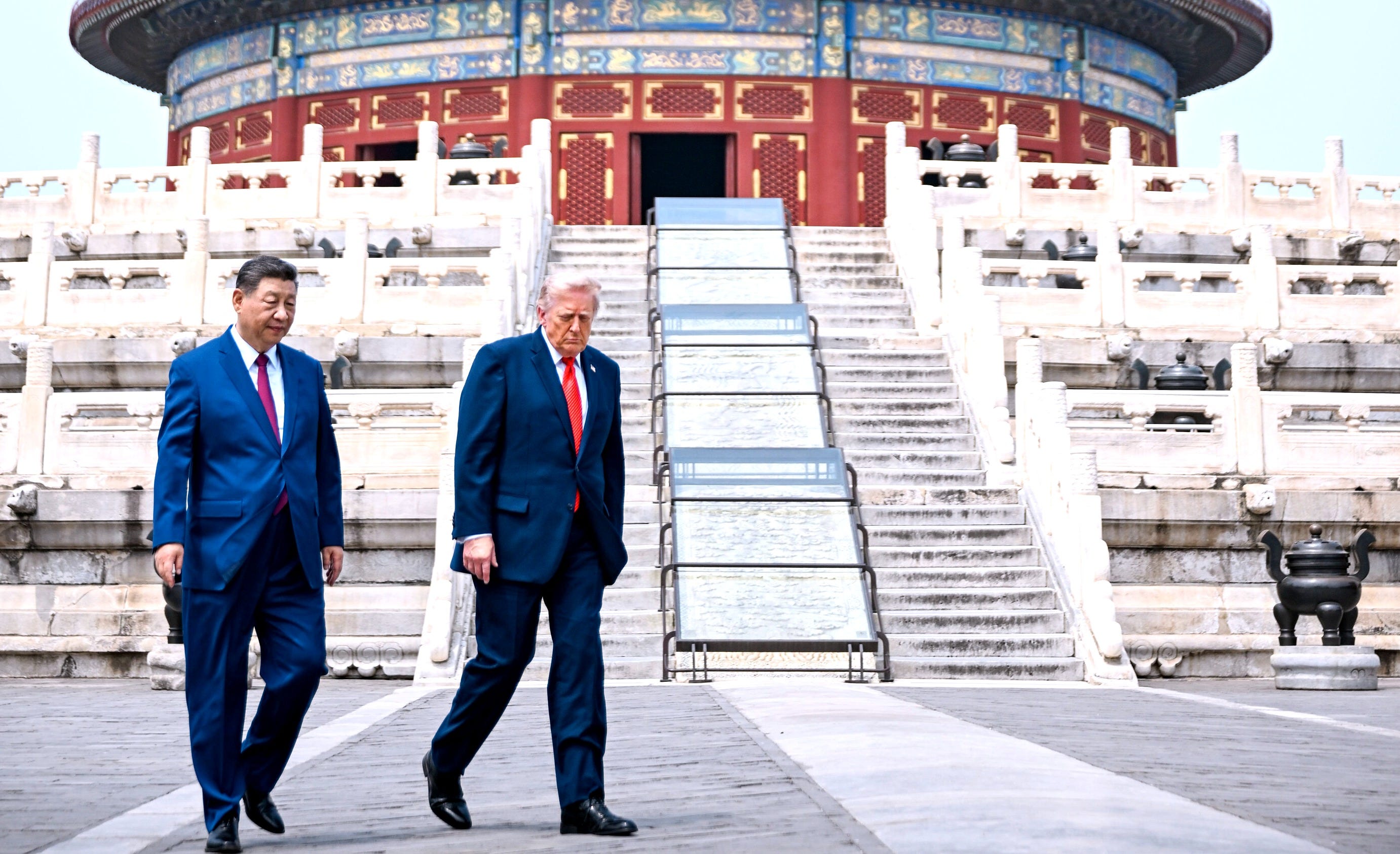
Beijing received Donald Trump with the full weight of diplomatic ceremony: honour guards, a visit to the Temple of Heaven — where emperors once prayed for peace and harvest — and a private dinner at Zhongnanhai, the hermetic heart of Chinese power, nestled beside the Forbidden City.
And yet, after two days of summit, not a single agreement was signed. Nothing on tariffs, nothing on semiconductors, nothing on Iran, nothing on Taiwan.
Picture the scene: in the Great Hall of the People, Trump and Xi sit facing one another.
Between them, metaphorically, stand Jensen Huang of NVIDIA — whose chips power the world’s artificial intelligence and cannot be sold to China —, Tim Cook of Apple, whose entire supply chain depends on Chinese factories, and Stephen Schwarzman of Blackstone, the man who has served as a silent interpreter between the two powers for two decades. Hostages and mediators at once.
For this, in the end, is what the Beijing summit amounted to: not a negotiation between two nations, but a performance of an interdependence that neither side wants any longer, yet neither knows how to dismantle without inflicting grievous harm upon itself.
How, then, should such an encounter be read? As a diplomatic failure, or as something more subtle — a photograph of a world order quietly reshaping itself, slowly and without fanfare?
From the American vantage point, Trump returned home with 200 Boeing aircraft and a vague promise of additional oil purchases. From the Chinese side, Xi received the president of the world’s foremost power without yielding an inch on any dossier.
From the rest of the world — Europe, Canada, Japan, South Korea — the spectacle is observed with a growing conviction: that entrusting either Washington or Beijing with the role of anchor for the global order is no longer a viable proposition. The watchword is singular: go it alone.
In this edition, we examine the summit through five lenses: the American position, the Chinese position, the commercial deals on the table, the Iranian dimension, and the question — never resolved, always combustible — of Taiwan.
